Midlife Mavericks
On Monday, I thought it was a glitch.
One LinkedIn message. Then another. Then three from the same billion-dollar hedge fund.
By 5pm my phone buzzed. “Guess who blew up on X?”
I had no idea what he was talking about. I’m not on X.
The thing that exploded was the podcast I almost didn’t do. The one I nearly backed out of because I was scared to be visible.
What happened next is a story about accidental authority, and why you don’t need video to build it.
But first, let me ask you something:
What would you say if you weren’t afraid of being judged?
Answer that honestly before you read on.
I posted this on LinkedIn mid-meltdown. It sums up the week better than I could in hindsight:
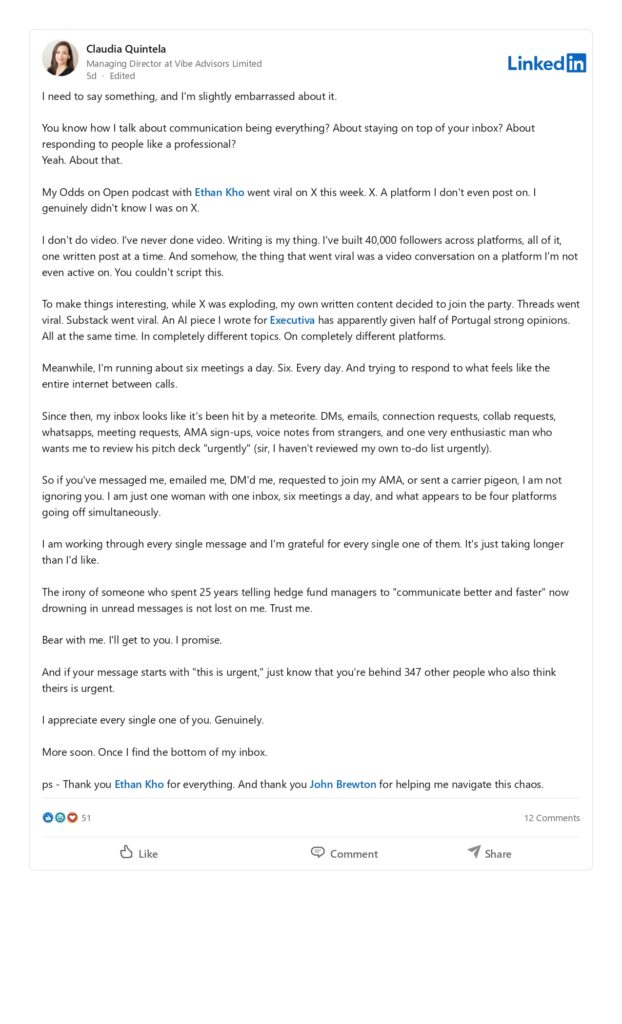
The Fear I Didn’t Admit Out Loud
The hedge fund world is not Instagram. It’s closed, male-dominated, opaque. Reputation travels faster than performance.
And I have strong opinions.
So when I was invited onto the Open Podcast months ago, my first thoughts were:
“What if I say something wrong?”
What if I stand out too much?
What if peers judge me?
What if clients think I’ve crossed some invisible line?
Visibility in that world feels dangerous. Standing out can feel like career suicide.
So I hesitated. Hard.
Quote of the Week
“You wouldn’t worry so much about what others think of you if you realized how seldom they do.”
Eleanor Roosevelt
The Week It Went Sideways
I was supposed to have a quiet week. Big hedge fund conference in Miami. Most clients out of office. I’m in London. Calm. Focused. Low-key.
Instead, between 100 and 200 new connection requests landed. Around 50 meeting requests. Top billion-dollar firms, recognizable names, multiple people from the same company reaching out. And not just “Nice to connect,” but actual meeting requests with context and enthusiasm.
“We’d love to meet.”
“Can you meet tomorrow? Here’s my calendly.”
“We watched it several times.”
“We feel like we know you.”
That last one is the part that messed with my head, because suddenly I’m on calls with people who know more about me than I know about them. They’ve watched the podcast. They’ve seen the Substack. Meanwhile I’m staring at their LinkedIn trying to piece together who they are.
It’s exposing. Intimate, almost. And yes, uncomfortable as hell.
The Exposure Nobody Warns You About
I’ve had viral Threads before. Tens of millions of views.
When it’s written, I know how to handle backlash. Text feels controlled.
But this was a video, on a platform I’m not even on, going viral without me touching it. At the same time, Threads was blowing up, Substack was surging, 700 new followers in days.
I wasn’t orchestrating a launch. I was living my life. And I wasn’t ready for what that felt like.
But I noticed something: people who’d seen the podcast multiple times were warmer on calls, faster to trust, quicker to skip the small talk. One guy opened with, “I feel like I already work with you.” Another skipped the intro entirely and went straight into deal terms. A third sent a voice note before we’d even spoken, like we were already mid-conversation.
Repeated exposure to someone’s voice and face builds a kind of familiarity that no amount of polished copy can replicate. And when what they saw felt genuine, not rehearsed, not strategic, just honest, it lowered the barrier even further.
The word people kept using? “Genuine.” Not polished or impressive. Genuine.
In a male-dominated, hyper-strategic space, that turned out to be disarming.
What I Actually Did (And Why You Don’t Need Video)
I didn’t try to sound clever. I didn’t sanitise my views. I didn’t perform.
I was blunt. Honest. Me. Which, ironically, is what felt the most dangerous.
Because when you’re polished, you’re protected. When you’re just… you, there’s nowhere to hide. And that scared the shit out of me.
A friend texted me mid-week: “Remember a year ago you didn’t even want to show your face!”
She’s right. A year ago I wouldn’t have done the podcast. I wouldn’t have posted about it. I definitely wouldn’t be writing this.
But the opportunities that came from it didn’t come from a strategy deck. They came from a conversation I almost talked myself out of having.
And here’s the part that should reassure you: my LinkedIn bio wasn’t optimised. My profile photo is years old. I had no content strategy for that platform, no funnels, no lead magnets waiting. None of the boxes were ticked. And none of it mattered, because the podcast did the work before anyone clicked through to check.
You might be thinking: “That’s nice, Claudia, but I’m not doing a podcast.” Good. You don’t need to. The reason this worked came down to two things:
- Clarity of opinion. I said what I actually thought instead of what sounded safe.
- Zero performative energy. No script, no pitch, no carefully worded corporate-safe version of myself.
When your LinkedIn, Threads, newsletter, conversations all say the same thing in your real voice, people start coming to you instead of the other way around. I’ve had it happen enough times now to know it’s not a fluke. It’s what consistency does when it compounds over time.
If I had said no to that podcast, this week would have been quiet. Comfortable. Predictable. No 50 meeting requests. No new rooms. No serendipity. No bloody inbox crisis.
The Awkward Truth About Being Known
The hardest part wasn’t the influx. It was walking into meetings where people said: “We feel like we know you so well.”
That imbalance is strange. You are exposed. They are not.
But they don’t know you. They know your thinking. And thinking is exactly what they’re buying. So the discomfort you feel being visible? That’s the cost of entry. Not a warning sign.
Your Move This Week
Not a podcast. Just this:
Write one clear, non-performative opinion in your field this week. Something you actually believe that you’d normally water down. Post it. No overthinking. No disclaimers. No “just my two cents” caveat at the end.
One clean truth.
Then reply andtell me what you posted. I want to see it. Bonus points if it made you slightly nervous.
See you next Wednesday,